
Organoclay for epoxy coating: Organoclay (organobentonite) serves as a high-performance, easy-dispersing organo clay rheological additive exclusively optimized for epoxy coating systems.
Derived from bentonite, this premium rheology modifier features adaptability to low to high polarity solvent and resin systems, with superior dispersion performance and a broader application range. Widely applicable to water-based, solvent-based and oil-based epoxy paints including industrial, decorative and top-grade coatings, it delivers excellent anti-settling, anti-sagging and thixotropic properties.
With stable physical and chemical indicators, simple dispersion conditions and flexible addition ratios, organoclay effectively optimizes the construction performance and long-term storage stability of epoxy coating, making it a core thickening and rheological adjustment material for epoxy coating formulations.
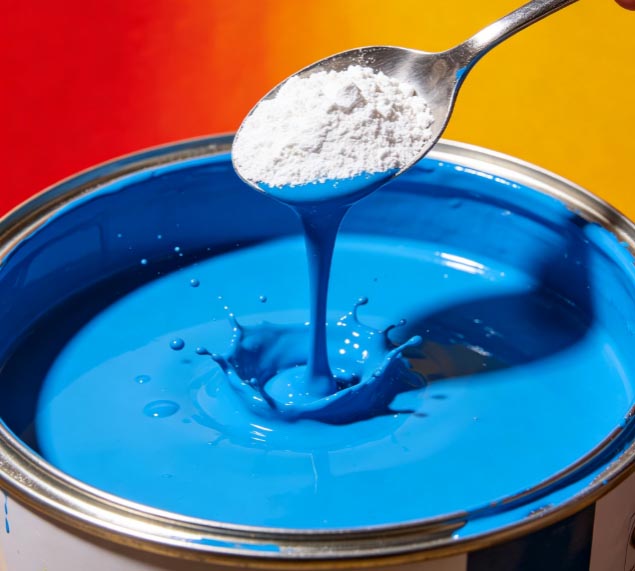
Organobentonite for Epoxy Paint Rheology Modification
1. What is organoclay for epoxy coating?
Organoclay is an easy dispersing organo clay rheological additive made from bentonite. It is specially applied for epoxy coating and adaptable to solvent and resin systems covering low polarity to high polarity range. Compared with CP-22, CP-23 behaves better dispersion and wider application range.
2. How to select suitable organobentonite for different epoxy paint systems?
Epoxy paints are divided into water-based and solvent-based systems with matched organoclay products: If it is epoxy emulsion (water-based epoxy system), water-based bentonite is recommended; if it is solvent-based epoxy resin system, oil-based organo-bentonite shall be adopted. For solvent-based epoxy paint systems, most organo-bentonite models are applicable.
Organoclay for epoxy coating CP 180 and CP 40 are the most cost-effective options, while CP-MPZ and CP-APA are high-quality models for high-standard epoxy resin application scenarios.
3. What are the application scope of organobentonite for epoxy coating?
Organobentonite features wide application adaptability for epoxy coating. It is suitable for most solvent-based paints and coatings, water-based and oil-based coatings including top grades paint, decorative paint and industrial paint. Besides, it can adapt to solvents of varying polarities in epoxy paint systems.
4. What core performance advantages does organoclay have in epoxy coating?
Organoclay (organobentonite) has multiple excellent performances for epoxy coating: It has excellent dispersibility and highly uniform particle size; presents remarkable gelling effect, transparent appearance and light color; owns good thixotropic properties and low viscosity, which can significantly improve the thixotropic performance of paints and coatings.
Most importantly, it possesses outstanding anti-settling and anti-sagging properties during long-term storage of epoxy paints, making it an ideal thickening rheology modifier for coating manufacturers.
5. About the dispersion performance and activator use of organoclay for epoxy coating?
Organoclay has superior dispersion performance in epoxy coating systems.
Organoclay for epoxy coating: It can be directly added to epoxy paints in most formulations, and achieves more thorough dispersion under high shear conditions. Adding a polar activator can significantly enhance its activation properties, and many formulas can realize easy dispersion without polar activators.
A small amount of polar activator can be added properly to optimize product performance.
6. What is the recommended addition rate oforganoclay?
For conventionalepoxy coating formulations, the recommended addition rate of organoclay is 0.2% to 2% based on the total weight of the formulation. For partial lubricating grease scenarios, the conventional addition rate is 7% to 15%. High shear force is a key condition for the complete dispersion of organoclay.
7. What are the physical and chemical properties of organoclay for epoxy coating?
The detailed properties are as follows:
– Composition: Organic derivative of a montmorillonite clay
– Appearance: Fine white powder
– Moisture content (105℃, 2hr): ≤3.5%
– Loss on ignition (1000℃): (34.5±1.5) %
– Bulk density: 0.40~0.60g/cm3
– Fineness (<74μm, %): ≥99%
– Dispersion fineness (μm): ≤10
8. What is the safety information of organoclay?
All safety information of organoclay is provided in the Material Safety Data Sheets.
9. What are the packaging specifications of organoclay for epoxy coating?
The product adopts kraft paper bag with PE liner or multi-wall paper sacks packaging, and customized packaging is supported. Conventional specifications are 25kg/bag or 22.68kg/bag, and customized weight specifications are available.