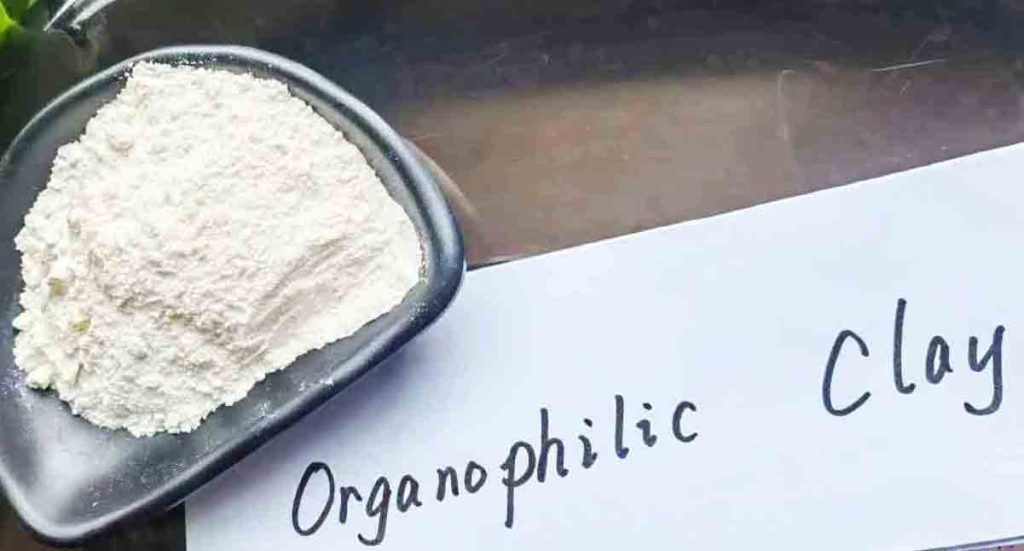
organophilic clay bentonite
Solvent Based Organoclay Rheological Additive CP-26
CP-26 is a kind of organo clay rheological additive. It is used in systems of non-polar to medium polarity aliphatic and other solvents (ketones, ester, ether esters, alcohols, aromatic).It is a economical grade of easy dispersing organoclay powder .
Advantages of organophilic clay bentonite
- Fine particle size.
- The gel is of light colour and high clarity.
- Easy to use, no need to pre-gel.
- Consistent development of rheology.
- Can be used to post correct
Organically modified bentonite — commercially known as organoclay — is the non-aqueous form of bentonite clay used as a rheology modifier and anti-settling agent in drilling fluids, coatings, and lubricating greases; full product specifications are at organoclay — the commercial form of organically modified bentonite. The natural bentonite clay properties, including swelling capacity, mineral composition, and industrial grades, are described in bentonite clay — natural properties and modified bentonite grades. To source organically modified bentonite or natural bentonite grades, see organoclay supplier — organically modified bentonite factory.
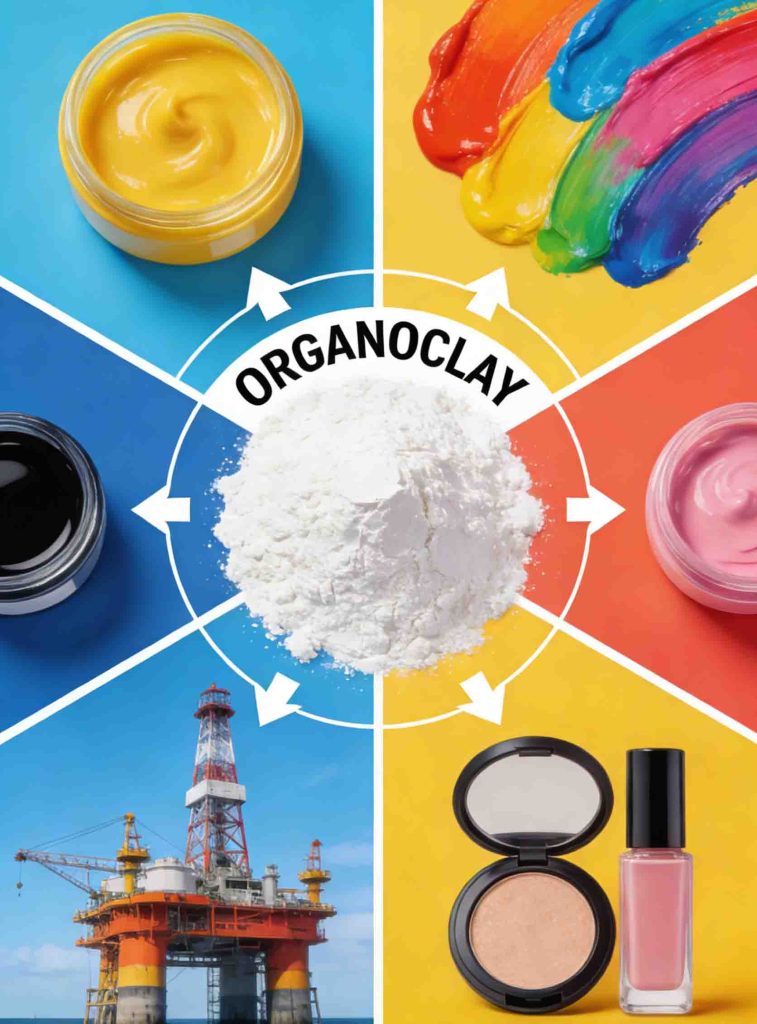
Organophilic Clay Bentonite Widely Applications
organophilic clay bentonite
Organophilic clay bentonite
Composition | Organic derivative of a montmorillonite clay |
Appearance | Fine white powder |
Moisture content (105℃,2hr) | ≤3.5% |
Loss on ignition max,%(1000℃) | 26%-29% |
Bulk density | 0.45~0.50g/cm3 |
Fineness (<74μm, %) | ≥98% |
Dispersion fineness (μm) | ≤40 |
Organophilic clay bentonite
- Paints
- Sealants and adhesive
- Ink
- Cosmetic
- Nano-composite
- Grease
- Oil Drilling Mud
organophilic clay bentonite can be added directly in powder without polar activator and making pre-gel. But better performance may achieved if polar activator is added and pre-gel procedure is effected.
The addition is recommended to be before grinding procedure to get the best effectiveness. Addition level is commonly 0.2%~1.0%. Normally addition level of polar activator is about 20%-30% by weight of CP-26.
Package of organophilic clay bentonite
Kraft bag or kraft complex interior with PE or customized.
25Kg/Bag,16MT/20FCL with pallet,25MT/40FCL with pallet.
Storage
OrganoBentonite has a shelf life of 2 years, and should be stored in ventilated cool and dry place.
Safety
All safety information is provided in the Material Safety Data Sheets for Zhejiang Camp-Shinning Co.,Ltd..
The pre-gel method is the primary approach for applying organic bentonite.
The core process involves first preparing a solvent system, then precisely controlling the proportion of dry powder added, and finally forming a stable colloid through high-speed dispersion.
This method meets the thickening and thixotropic requirements of most industrial applications.
Standard Preparation Steps
1. Solvent Ratio: Select a suitable base solvent and mix it to a concentration of 85%–97% to serve as the base for gel preparation;
2. Powder Addition: Add 5%–10% organic bentonite powder to the mixed solvent, ensuring uniform dispersion of the powder;
3. Activation Treatment: Add 3%–5% polar activator to help the bentonite fully unleash its performance;
4. High-Speed Mixing: Stir at 2500 rpm for 10–20 minutes until a pre-gel colloid with good flowability is formed.
Addition Process for Compatible Systems
For resin systems with excellent wettability, such as epoxy, polyester, and acrylic resins, adding surfactants can optimize gel stability. The specific addition sequence is as follows:
1. First, thoroughly mix the paint pigment with the solvent;
2. Add the organic bentonite powder and continue mixing for 10 minutes to achieve initial dispersion;
3. Add the polar activator to activate the powder’s properties;
4. Add the surfactant to enhance system compatibility;
5. Disperse the pigments to ensure uniform color;
6. Adjust the solvent quantity to dilute the mixture to the viscosity required for the process.
This process is simple to operate and does not require the preparation of a pre-gel. It is suitable for resin systems with good wettability and grinding processes, simplifying production workflows and improving efficiency.
Standard Addition Steps
1. Mix the solvent and color developer to establish the base system;
2. Add organic bentonite powder and mix for 10 minutes to achieve initial dispersion;
3. Add a polar activator to enhance gelation;
4. Add a surfactant to optimize system stability;
5. Disperse the pigment to meet coloration requirements;
6. Adjust the viscosity to meet production standards.