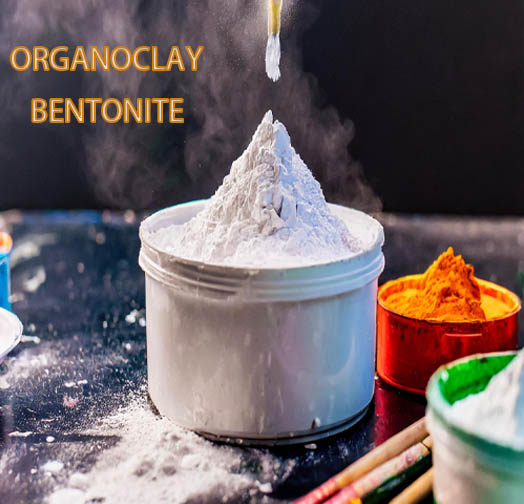
Organoclay | Organophilic Clay CP-2 also named amine treated Bentonite.
In diesel oil based fluids,organophilic clay viscosifier CP-2 are used to increase carrying capacity and suspension properties, providing support for weight materials and improved cutting removal. Organophilic bentonite also aids in filter-cake formation and filtration control.
Properties
Composition Organically modified bentonite clay
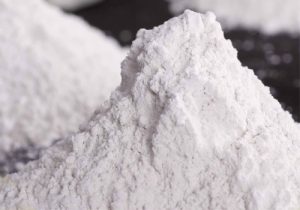
Physical appearance Off white to tan free-flowing powder
Moisture content (105℃,2hr) ≤4%
Particle size (<76μm or 200mesh) ≥95%
Specific Gravity 1.6-1.8
Advantages
Effective viscosifier and gellant
Aids control of fluid loss to the formation
Increases emulsion stability
Improves cuttings carrying and hole cleaning capacity
Suspends weighting materials and other solids
Confers temperature stability to the fluid
Application
Base oil:
Diesel Oils
Crude Oils
Mineral Oils
Synthetic Oil
Viscosifying drilling Fluids:
Oil based drilling fluids
Invert emulsion fluids
Workover fluids
Completion fluids
Casing packs
Packer fluids
Spotting fluids
Package
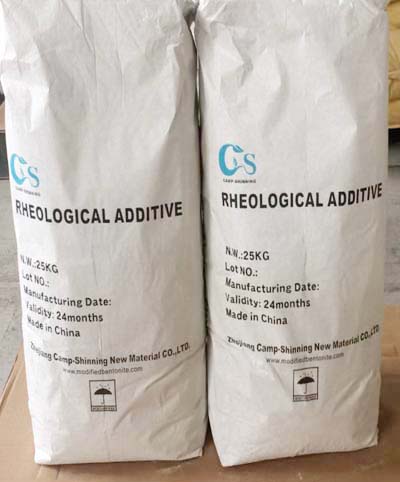
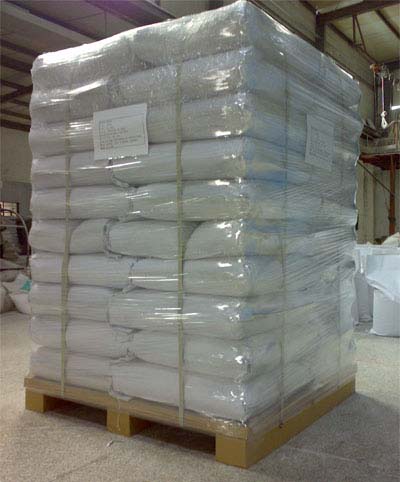
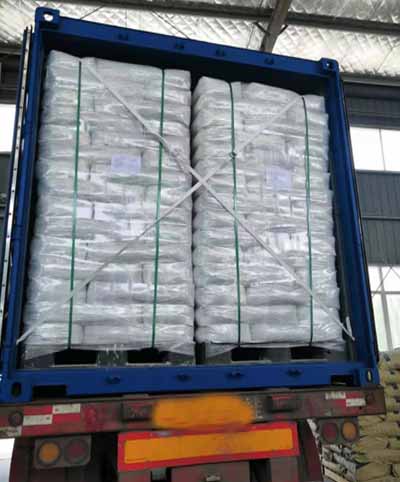
Organoclay | Organophilic Clay CP-2 is packed in 50lb(22.7kg) or 25kg/bag or customized,multi-wall paper sacks or Kraft paper bag with PE liner or customized.
Storage
CP-2 Store in a dry, well-ventilated area with temperature of 0℃-30℃. Keep container closed. The quality guarantee period is 24 months.
Notice
The information on use is based on data which are believed reliable, but any recommendation or suggestion made is without guarantee or warranty, since the conditions of use are outside our control. All products are sold on the conditions that purchasers shall make their own tests to determine the suitability of such products for their purpose and that all risks are assumed by user. We disclaim any responsibility for damages resulting from careless or improper handling or use. Nothing herein is to be taken as permission, inducement or recommendation to practice any patented invention without a license.
Internet address: https://www.rheologicaladditive.com/ and email address: [email protected]
Whatsapp / Wechat: +86-13185071071
rheopectic and thixotropic
Efficient Dispersion and Polarity Activation
CP-40 exhibits excellent dispersion properties in high shear environments, but to achieve optimal efficiency, it requires the aid of polar activators.
Significantly, this process requires no additional heat, simplifying the process. Typically, CP-40 is added at a level of 0.2% to 2.0%, while the recommended level of polar activator (e.g., 95% ethanol or 95% methanol) is 45% to 60% by weight of CP-40.
In xylene systems, this percentage can be appropriately adjusted to 30% to 40% to meet the needs of a particular system.
Pre-gel Preparation Process
In order to fully utilize the performance of CP-40, the preparation of pre-gel is particularly important. The process is simple and efficient, the specific steps are as follows:
Solvent injection: First, an appropriate amount of solvent is injected into the mill to provide the basis for subsequent mixing.
CP-40 addition: Under continuous stirring, slowly add CP-40 into the mill, which is usually 6% to 10% of the total amount of pre-gel.
High Speed Mixing: High speed mixing is initiated for 5 minutes to ensure that CP-40 is uniformly dispersed in the solvent.
Polar Activator Addition: Subsequently, a predetermined amount of polar activator is added and high speed mixing is continued for 5 minutes to promote full activation and dispersion of CP-40.
Rheology and thixotropy analysis.
Rheology: CP-40 can form a stable gel structure in the solvent system, giving the system excellent rheology.
Its thickening effect is remarkable, effectively preventing the coating from delamination and precipitation during storage and use, ensuring the uniformity and stability of the coating.
At the same time, CP-40 also has the characteristic of shear thinning, that is, the viscosity is reduced under the action of shear force, which facilitates the flow and spreading during the construction process and improves the construction efficiency.
When the shear force is removed, its viscosity can be quickly restored, preventing the paint from hanging.
Thixotropy: The thixotropy of CP-40 is especially critical in coating systems. At low shear rates, its high viscosity helps prevent pigments and fillers from settling, while at high shear rates, the reduced viscosity facilitates the smooth flow of coatings.
This thixotropic loop not only ensures the stability of the coating during storage and use, but also enhances the quality of the coating film.
By controlling the flow and spreading of the coating, CP-40 results in a more uniform, smooth and flat coating film with enhanced scrub and weathering resistance.