
Choosing the Right Organoclay for Oil-Based Drilling Fluids
Oil Drilling Organoclay ,In oilfield drilling applications, organoclay — the core viscosifier for oil-based drilling — selecting the right grade is not simply about choosing the highest specification product. The key factor is compatibility between the rheological additive and the drilling fluid formulation.
Different base oils, emulsifier systems, operating temperatures, and polarity levels can all affect the final rheological performance. That is why experienced suppliers often recommend testing multiple organoclay grades before determining the most suitable and cost-effective solution.
At Camp-Shinning, we supply several organoclay grades for oil-based drilling fluid systems, including CP-2, CP-EZ, and CP-RL, helping customers organoclay viscosity control in oil-based mud, suspension performance, and overall OBM viscosifier selection and formulation efficiency. Our grades are proven in organoclay for oil well drilling fluids globally, with detailed technical data on organoclay in OBM drilling fluid systems. Key performance metrics include organoclay gel strength optimization in drilling mud and organoclay oil-based mud stability under high pressure.
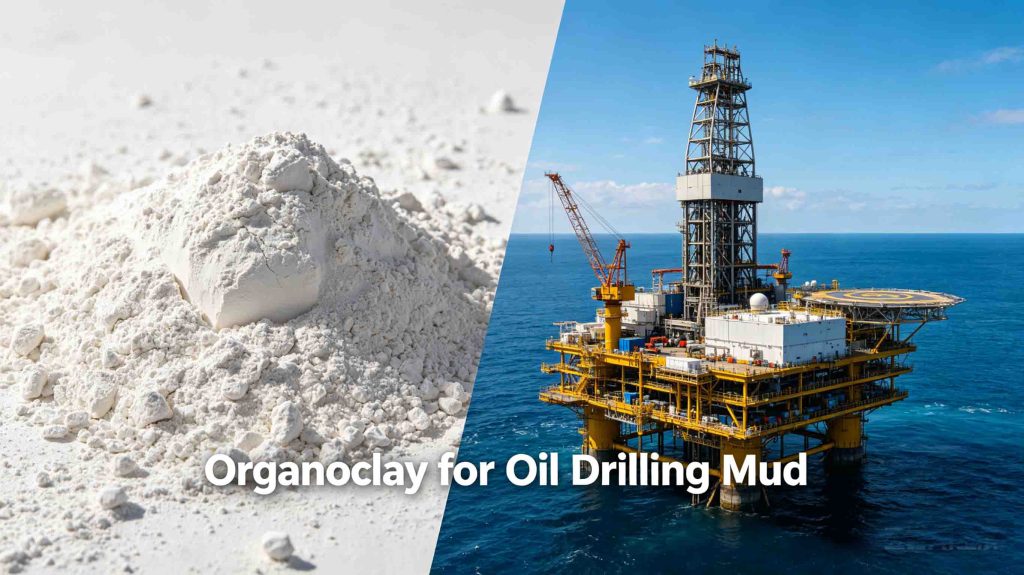
organophilic clay for oil drilling
Oilfield rheological additive CP-2 is currently one of the most widely exported organoclay grades for oil drilling applications in Mexico. Through different distributors, this product has been supplied to the market in large volumes for many years.
Its core advantages include:
- Competitive pricing
- Stable quality
- Reliable rheological performance
- Strong overall cost-performance ratio
For many drilling fluid manufacturers, especially in Latin America, formulation stability and operational economics are often more important than isolated laboratory indicators.
In practical applications, the final evaluation of an organoclay should consider the entire drilling fluid system, including:
- viscosity development,
- suspension performance,
- thermal stability,
- processing behavior,
- and formulation compatibility.
Because of its balanced performance and long-term market acceptance, oil drilling organoclay CP-2 has become a highly suitable choice not only for Mexico, but also for Brazil, Argentina, Venezuela, Colombia, and other South American markets.
With more than 20 years of production experience, we remain confident in the overall value and consistency of oil drilling organoclay CP-2 for oil-based drilling fluid applications.
Organoclay for synthetic oil systems
High temperature organoclay CP-EZ is designed for both mineral oil-based and synthetic oil-based drilling fluid systems.
One of its key advantages is its excellent high-temperature resistance when used in properly matched formulations.
Key Features of Oil Drilling Organoclay CP-EZ
- Compatible with mineral oil systems
- Compatible with synthetic oil systems
- Good thermal stability
- Efficient rheology control
- Stable suspension performance
oil drilling organoclay CP-EZ is especially suitable for drilling fluid formulations that require improved thermal resistance and stable viscosity performance under demanding operating conditions.
Because different drilling fluid systems behave differently, actual performance should always be verified through formulation testing.
Oilfield rheological additive CP-RL is a newer organoclay grade developed as an upgraded option compared with oil drilling organoclay CP-2.
In general, its performance is slightly better, while the price is approximately USD 100 per metric ton higher.
Depending on the drilling fluid formulation, oil drilling organoclay CP-RL may provide:
improved rheological efficiency,
better suspension stability,
and enhanced viscosity development.
However, the “best” product always depends on the compatibility between the organoclay and the complete formulation system.
In some formulations, oil drilling organoclay CP-2 already delivers excellent results at a lower overall cost. In others, the additional performance of CP-RL may justify the higher material cost.
This is why we usually recommend customers evaluate multiple grades during laboratory testing before finalizing the formulation.
Organoclay in oil-based drilling applications serves as both the viscosity-building agent and the structural backbone of the gel network within oil-continuous mud systems. Typical field usage runs 5 to 20 kg per cubic meter of mud volume (approximately 1.8 to 7 lb/bbl) depending on target mud weight and borehole conditions. It delivers a rheological response that distinguishes it from polymer viscosifiers: yield point and gel strength increase substantially while plastic viscosity rises only modestly — raising suspension-critical parameters without creating excessive flow resistance during circulation.
The operational mechanism is physical: under high-shear mixing conditions, organoclay platelets separate and distribute throughout the oil phase, then spontaneously form an interconnected lattice network when shear is removed. Circulating the mud breaks down this network (reducing equivalent circulating density during drilling), while pump shutdown allows near-immediate network reconstruction — holding cuttings and weighting material stationary during connections, tripping, and equipment downtime. Unlike cellulose polymers and xanthan-based viscosifiers, the structural element here is an inorganic mineral platelet, thermally stable through wellbore temperatures beyond 200°C, which is why organoclay remains the gelling material of choice for deep and HPHT well programs globally. To source drilling-grade organoclay with batch-specific COA and API-standard test data, submit your base oil type, target mud weight, and circulating temperature for a grade recommendation.
In oilfield drilling fluids, product selection should not rely on a single technical parameter alone.
A drilling fluid additives for oil-based mud systems must work together with:
- the base oil,
- emulsifier package,
- system polarity,
- temperature conditions,
- and processing method.
The real objective is to achieve the best balance between performance, stability, and formulation cost.
For this reason, professional drilling fluid rheology modifiers manufacturers often test several organoclay grades simultaneously to identify the most suitable solution for their specific system.
#organoclay Mexico
#organoclay Brazil
#organoclay South America
get organoclay for oilfield from verified supplier: Camp-Shinning For broader context, explore rheology additives for oilfield drilling — suspension performance and organoclay for all oil-based drilling fluid types. We also supply organic bentonite for drilling fluid formulation and organophilic bentonite rheological additive for HPHT drilling. Compare with bentonite clay drilling mud to understand key performance differences. Contact our oilfield chemical suppliers team or visit our drilling chemicals manufacturer page for bulk pricing.
Frequently Asked Questions — Organoclay in Oil-Based Drilling Fluids
What dosage of organoclay is typically used in oil-based drilling fluid?
Field usage spans 5 to 20 kg per cubic meter of mud volume (roughly 1.8 to 7 lb/bbl). Lower-density programs typically fall in the 5–10 kg/m³ range. High-density muds at 2.0+ sg, or wells with elevated circulating temperatures, may require 12–20 kg/m³ to achieve adequate cutting suspension and barite support.
The relationship between dosage and rheological response is nonlinear: beyond an optimal treat rate, additional organoclay produces diminishing yield point gains while gel strength continues to climb. Treat-and-test procedures using actual field mud samples at target temperature and salinity conditions are the reliable method for confirming optimal loading before rig deployment.
→ Grade and dosage guidance for your well program: contact our drilling fluids technical team.
What is the difference between yield point and gel strength in OBM, and how does organoclay affect each?
Yield point (YP) is a steady-state measurement — the minimum shear stress required to initiate and sustain fluid movement during active circulation. It governs cutting-transport efficiency: a YP that falls too low allows cuttings to accumulate; one that climbs too high creates elevated circulating pressure and risks lost circulation.
Gel strength is time-dependent. The 10-second reading captures how quickly the gel network re-establishes after pumps stop; the 10-minute reading reveals whether the network continues strengthening over a static period. A healthy gel profile shows the 10-minute value remaining within roughly twice the 10-second value — what drilling engineers call a flat gel.
Organoclay primarily controls YP and both gel measurements, while its effect on plastic viscosity is comparatively small. This selective influence — building suspension parameters without proportionally increasing flow resistance — defines the rheological advantage of organoclay as a drilling fluid additive.
What is a flat gel profile in oil-based mud and why do drilling engineers specify it?
A flat gel profile means the mud’s gel strength after 10 minutes of static rest is less than double its gel strength after 10 seconds. Progressive gels — where strength climbs steeply during static periods — create restart pressure surges that can fracture permeable intervals and amplify swab pressure during tripping.
The platelet network in properly dispersed organoclay-treated OBM establishes quickly and then stabilizes rather than continuing to build — producing the flat gel behavior drilling engineers target. This time-stable gelation is a structural characteristic of the inorganic platelet network, distinct from the continued cross-linking behavior seen in some polymer-based viscosifiers at elevated temperature.
→ Contact our team for OBM formulation guidance including gel profile management.
Why does organoclay maintain rheological performance at high wellbore temperatures better than polymer viscosifiers?
Polymer viscosifiers degrade through thermal bond-breaking and hydrolytic attack under sustained high temperature, losing rheological performance irreversibly. Organoclay operates on a different structural foundation: viscosity development is driven by an inorganic mineral platelet — the montmorillonite crystal lattice — which retains structural integrity at temperatures far above anything encountered in oil and gas drilling.
This thermal stability is why organoclay is the specified gelling agent for HPHT well programs where polymer-based fluid systems either degrade during extended exposure or require impractically high concentrations to maintain target rheology at depth. View our drilling-grade organoclay range for HPHT-capable grade specifications.
What test certificates and documentation should accompany a drilling-grade organoclay shipment?
A complete documentation package should include: a batch-specific Certificate of Analysis (COA) with measured values for moisture content, loss on ignition, and particle fineness; a Safety Data Sheet (SDS) for the destination country; and a Technical Data Sheet (TDS) covering performance parameters, recommended dosage ranges, and incorporation procedures for target base oil systems.
A COA that quotes only product specification ranges without batch-specific measured values and test dates does not provide sufficient traceability for oilfield supply chain audits. Request batch-numbered documentation with each shipment.
→ Request documentation samples and a technical quotation — all our drilling-grade shipments include batch-specific COA and full TDS as standard.