
Camp – Shinning is a professional manufacturer of organoclay in China, offering high-quality organoclay, also known as organophilic clay, for organoclay applications in drilling, paint, and grease, including lubricating grease, paints & coatings, and oilfield drilling fluids. Our organoclays provides outstanding thixotropy, organoclay as a rheology modifier, suspension stability, and anti-settling performance, ensuring superior formulation stability and performance in your products.
Camp Shinning is your trusted certified organoclay supplier in China and manufacturer in China.CP series rheological additive with good price and widely applications.Here,we will answer you what is organoclay and its chemical structure and organoclay uses across five major industries.Anyway,if you want to inquire about organoclay price per metric ton, pls contact us now.It will be a correct action for your purchase.
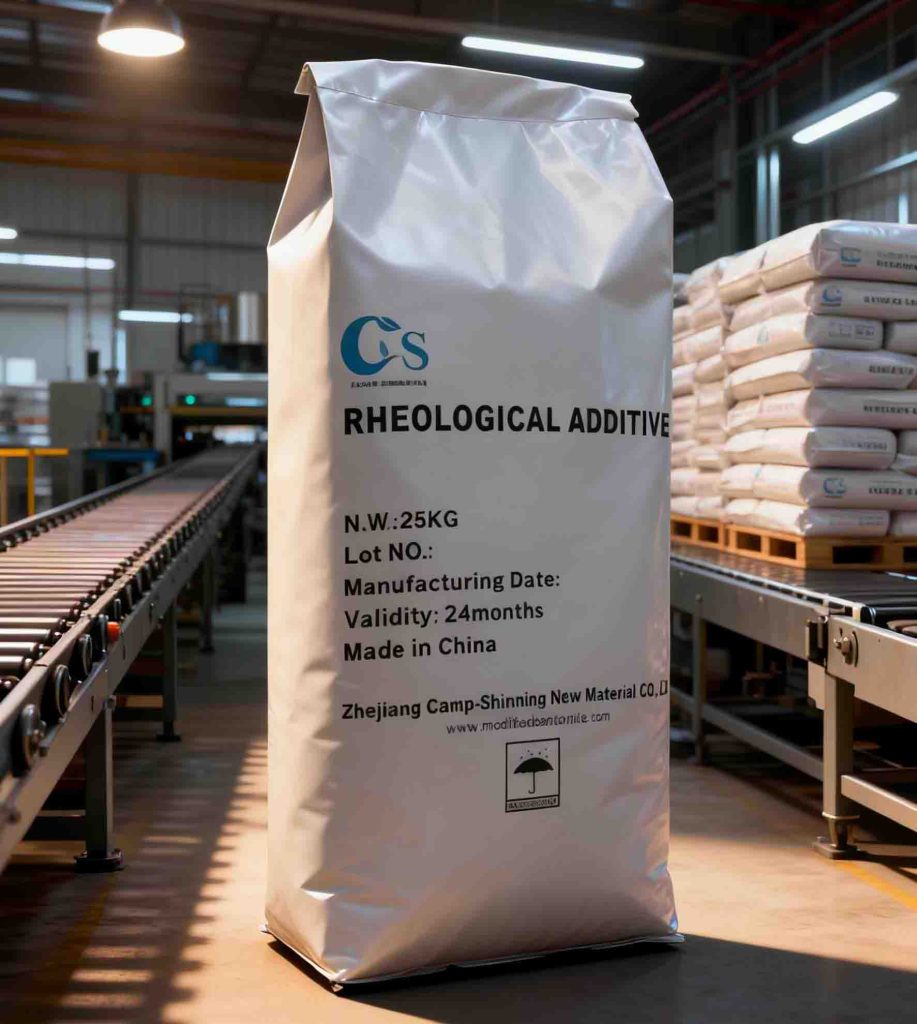
Organoclay is a chemically modified clay mineral — montmorillonite treated with quaternary ammonium compounds through a controlled ion-exchange process — converted from a water-swelling material into a rheological additive suited for organic systems. When incorporated into oil-based drilling fluids, solvent-borne coatings, lubricating greases, or adhesive compounds at dosages between 0.3% and 1.5% by weight, organoclay platelets exfoliate under high shear and rearrange into a continuous three-dimensional network throughout the liquid phase.
This network delivers practical thixotropy: high apparent viscosity at rest (holding pigments and solids in suspension during storage), combined with viscosity reduction under applied shear (enabling smooth pumping, spraying, or brushing during application). Once shear stops, the network rebuilds within seconds to minutes — preventing sag, drip, or settling in the final product. The material carries CAS No. 68153-34-4, EC No. 268-880-0, and HS Code 2508.10. Wet-process and dry-process manufacturing routes are both used commercially, with wet-process grades delivering tighter batch-to-batch consistency and higher gel clarity for coatings and cosmetic applications. To source organoclay directly from our factory, request a quote with grade specifications and target volume.
As a positive thickening rheological agent for coatings,paints, it has very good thixotropy in low, medium and high polarity solvents.
That is to say, it is a organoclay for coatings and paints, an anti-settlement agent for coatings, and a rheological agent for paints.
As a organoclay manufacturers and production capacity, all of our production strictly follows ISO standards.Welcome to inquire about prices and product manuals with us, and we will also provide free sample kilometer testing.
The organophilic bentonite clay as raw material we use in paints is divided into water-based bentonite and organoclay for solvent-based paint formulations.
Organoclay bentonite shows distinct organoclay vs bentonite — key differences in surface chemistry and performance. Organophilic clay is a process of cation exchange between layers. Organic clay can mainly be used in paint formulations or in oil-based drilling fluids as a thickener and suspending agent. Many organic bentonites have an adsorption effect, so they can remove organic pollutants. For this reason, it is applied in wastewater treatment. For complete organoclay properties and technical specifications, and a guide to organoclay types and grades available, visit our product pages.
Organoclay functions as a rheological additive across four primary industrial sectors. In solvent-based paint and coating formulations, it inhibits pigment and filler sedimentation during shelf storage while controlling applied-film viscosity to prevent sag on vertical surfaces. Within oil-based drilling fluids, it builds yield point and gel strength to transport drill cuttings upward through the borehole — maintaining fluid integrity at wellbore temperatures that can exceed 180°C in deep formations. Lubricating grease producers use organoclay as a non-soap thickener compatible with both synthetic and mineral base oils, achieving drop points substantially above those of conventional soap thickeners. In adhesives and sealants, it prevents vertical slump and provides the non-sag character required in construction joints and automotive sealing applications.
→ View organoclay grades by application: organoclay for grease · organoclay for drilling · organoclay for paint
Both materials share the same starting mineral — sodium montmorillonite — but differ fundamentally in surface chemistry and solvent affinity. Untreated bentonite carries sodium or calcium ions between its crystal layers; these ions attract water molecules, causing the clay to hydrate and swell in aqueous systems. Organoclay undergoes a surface treatment in which those naturally occurring interlayer cations are displaced by bulky organic nitrogen compounds (quaternary ammonium salts). This substitution shifts the clay surface from hydrophilic to organophilic.
The practical consequence is a complete inversion of behavior: standard bentonite loses structure in organic media, while organoclay remains inert in water yet forms structured, thixotropic gels in oils, aromatic solvents, esters, and other nonaqueous liquids. This difference defines the entire application range of each material — where organic-medium rheology control is needed, organoclay is the appropriate choice; water-based systems call for unmodified bentonite or other water-swelling clays.
→ See also: organophilic clay — the descriptively precise synonym used in technical and trade documentation.
Grade selection determines whether a polar activator is necessary. Conventional organoclay grades require approximately 20–30% ethanol or propylene carbonate (measured against organoclay weight) to open the interlayer structure and develop full gel strength in low-to-medium polarity solvent systems. Self-activating grades — manufactured with the activating compound already incorporated during production — eliminate this addition step entirely, simplifying plant processes and reducing VOC contribution from solvent activators.
High-polarity solvent systems such as ketones, esters, and higher alcohols can frequently drive interlayer swelling in conventional grades without supplemental activator, because the solvent itself provides the polarity differential needed. The definitive reference for any specific grade is its Technical Data Sheet, which specifies activator type, quantity, and recommended incorporation sequence for each target system. Contact our technical team for grade selection guidance for your specific formulation.
The four primary purchasing sectors are: oil and gas drilling fluid companies (OBM and SBM formulation); industrial paint and coating manufacturers (solvent-borne architectural, protective, and industrial coatings); lubricating grease producers (non-soap and specialty grease formulation); and adhesive and sealant compounders (polyurethane, epoxy, and silicone systems). Cosmetic manufacturers represent a fifth active market for white-powder, fine-dispersion grades used in anhydrous formulations including foundation bases, lipstick compounds, and sunscreen preparations.
Commercial procurement typically involves 25 kg multi-wall bags for laboratory or small-batch use, scaling to 500–1,000 kg jumbo bags for continuous production. Standard overseas B2B order quantities begin at one metric ton per grade, with full-container volume available from stocking manufacturers. Request a quote from our organoclay supplier team for pricing and lead time on your required grade and volume.
Thermal performance in oil-based drilling fluids depends on the grade selected and the specific fluid system composition. Standard activated grades maintain gel structure and yield point stability in wellbore temperatures up to approximately 150°C in diesel and mineral oil OBM systems. Purpose-built high-temperature grades retain meaningful viscosity contribution at circulating temperatures approaching 200°C, provided that base fluid and other additives remain stable at those conditions.
The thermal resistance mechanism resides in the inorganic platelet backbone of the clay — montmorillonite mineral itself remains structurally intact at temperatures far exceeding normal drilling conditions. The practical performance ceiling is set by the organic modifier rather than the clay matrix. For demanding HPHT applications, grade evaluation under actual reservoir temperature, pressure, and salinity conditions is recommended before field deployment. View our drilling-grade organoclay options or contact us for HPHT-specific grade recommendations.
When organophilic clays are used in organoclay for drilling fluids, they become an excellent suspending agent. At the same time, they have good high temperature and high pressure stability. In diesel system, synthesis system and mineral oil system, they can well display high quality YP value and ES value. Learn more about how organoclay works in oil-based drilling fluids, including YP/ES optimization and high-temperature stability in OBM systems.
Email: [email protected] Whatsapp : +86-13185071071
We recommend our organic clay bentonite to produce organoclay-based greases for industrial lubrication. It is a good thickener. Whether your base oil is diesel mineral oil or synthetic oil, we recommend our CP-180, CP-APA and CP-EZ10 to you. It will make your formula more complete to show its matching, whether it is Anti-settlement performance or thixotropic. Our organoclay is also engineered for organoclay for sealant and adhesive formulations, ensuring consistent rheology across high-demand industrial applications.
Organoclay applications
We are professional suppliers of organoclay applied in petroleum and natural gas drilling fluids.
In addition to having an adsorption effect, organic clay can improve the suspension performance and viscosity of emulsifiers, thereby achieving its thixotropic and rheological properties.
It is also used in paint coatings, as well as in the lubricant and cosmetic industries.
The main raw material of organic bentonite clay is montmorillonite mineral, which achieves its rheological properties and thickening properties in some formulations through modification with quaternary ammonium salt, as well as its thixotropic properties. Its primary goal is to increase viscosity and prevent pigment settling. It can be used in both oil-based and water-based paint coatings.
We recommend adding organoclay rheological additive to paint coatings, with the ideal dosage between 1% and 5%. Adding organic bentonite is to increase viscosity so that the entire formulation of the coating has an anti-sagging effect and prevents pigments and fillers from precipitating during storage.
Our hectorite organoclay includes non-polar, low-polarity, polar, and high-polarity types. They are all very easy to disperse and can be added at any stage of your paint coating production.
Some types of organoclay based products do not require the addition of polar activators and can be directly added to paint coatings in dry powder form. We recommend thoroughly stirring when adding organic bentonite to paint coatings to enhance its activation ability significantly.
The rheological properties and viscosity you ultimately want to achieve depend on your dosage, so we suggest determining your final usage amount through experimentation. We also recommend pre-gelling some low-polarity organoclay products.
This process can fully activate the hectorite organoclay, presenting its performance more completely. The longer you place it after pre-gelling, the better its effects will be. We recommend storing organoclay products in a cool, dry place, with a shelf life of typically 24 months.
It appears as gray-white powder, with moisture controlled within 3%. It is manufactured in China. The applications of organoclay based products include use in water-based systems and solvent-based systems.
Ultimately, it enhances the paint’s anti-settling and anti-sagging properties. Medium-polarity and high-polarity organoclay rheological additive can be directly added as dry powder to paint coating formulations. We offer you competitive organoclay price.
Camp Shinning has more than 20 years of experience in the organo clay bentonite industry. Frankly speaking, organo clay bentonite is mainly used in the following fields: paint, oil field drilling, cosmetics coating, ink, grease, sealant, etc.
They play different advantages in different application fields. From the perspective of chemical properties, when organobentonite is used in oilfield drilling, its greatest advantage is to use it as a suspending agent.
When organic clay bentonite is used in lubricating grease, ink, paint and coating fields, it mainly plays a role as a thickening rheology agent. It is also an excellent thixotropic agent, anti-settlement agent and so on.
In short, when you use our organo clay bentonite in these fields, it will not let you down, and it can also keep your entire formula stable at high temperature.
Of course, it is also a major function of organobentonite in the oil and gas field to lubricate and cool the bit and bring the color of the eye out of the well. Therefore, it is recognized that organic bentonite is an indispensable additive in the field of oilfield drilling.
When we talk about the use of organic bentonite in the cosmetics field, it is mainly used as a thickener organo clay, which mainly means that nail polish, shampoo, etc. in cosmetics need to use organic bentonite. Its needle’s diseased performance is indeed an important additive in the cosmetics field.
Bentonite based organoclay grades, Our organic bentonite includes low polarity bentonite, medium polarity bentonite and high polarity bentonite. We recommend doing some pre-gelling in some low-grade bentonite clay to promote better dispersion.

微信
+86-13185071071
扫码添加微信 · Scan to add WeChat